
How to Choose Your Room Colors With Confidence
- lebleuhomedecor
- Nov 19, 2025
- 3 min read

Updated: Dec 6, 2025
Most people stand in front of paint shelves and feel lost. You do not need theory. You need a simple way to read your room, pick a direction, test it fast, and decide. The guide below shows you how to choose colors that fit your light, your mood, and your existing furniture. Each tip includes real color examples you can start with today.

Start with the mood
Pick the feeling you want in the room. Calm, warm, fresh, or bold. The mood tells you the type of color to start with.
Examples
Calm: soft greens like “Sage” or “Retreat” (SW 6207).
Warm: muted clay tones like “Terracotta Beige” or “Cocoa Whip” (Dulux).
Fresh: soft whites with a warm base like “Swiss Coffee” or “Alabaster” (SW 7008).
Bold: deep tones like “Ink Blue” or “Forest Night” (Dulux).
Sit in the room for one minute and ask what is missing. Light, energy, calm, or depth. Pick a color direction from your answer.
Choose one anchor color
The anchor is the color you trust. It sets the direction for the room. Everything else works around it. Pick one safe tone that matches your style.
Examples

Modern style: “Pure White” or “Network Gray.”

Cozy style: “Latte Beige” or “Warm Clay.”

Natural style: “Sage Herb” or “Olive Grove.”
Use your anchor on the biggest surface. This might be your walls or your largest furniture.
You may also like: 15 Luxury Interior Design Tips Your Home Needs in 2026
Build a small palette around your anchor
Use three steps. Anchor. Supporting color. Accent.
Supporting colors either contrast with your anchor color or sit close to it on the wheel. Both approaches work, they create different moods.
Example palette
If your anchor color is "Sage", you can go supportive in two ways.
Complementary contrast like Alabaster or Warm Terracotta, which adds light and gentle warmth.
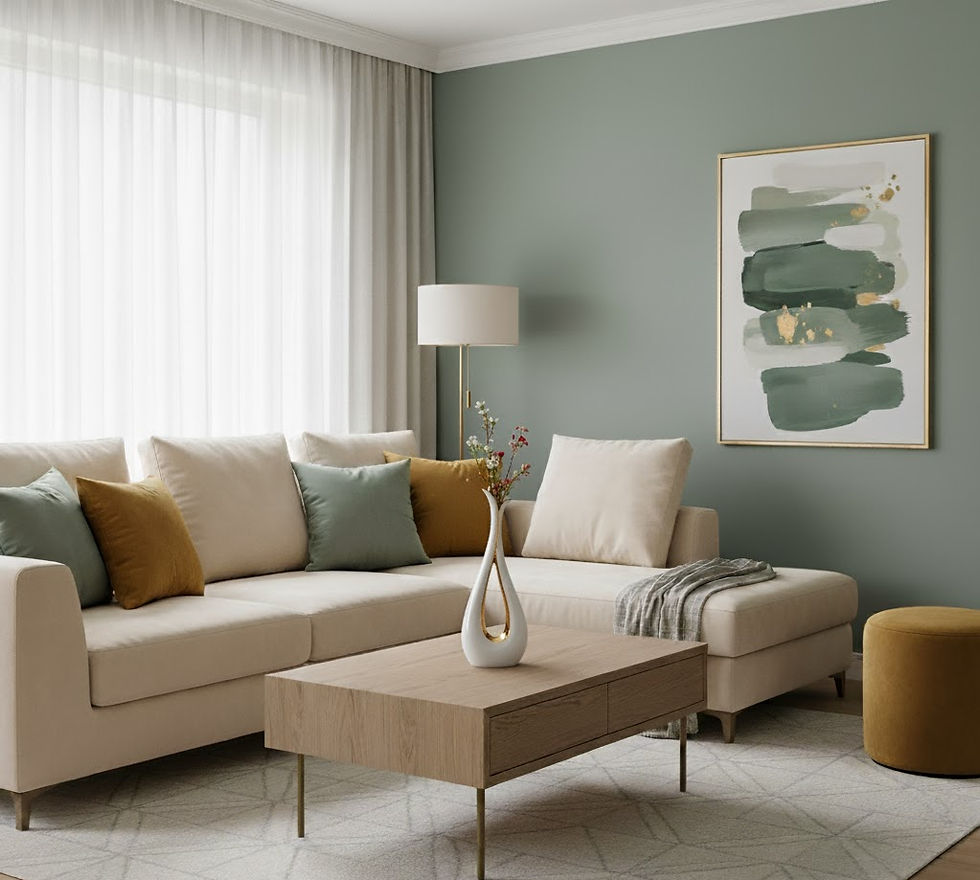
Harmonious support like Olive Drab or Warm Gray, which keeps the palette grounded and soft.

Pick colors that match your furniture
Look at your sofa, curtains, rug, or wardrobe. These items have colors you already live with. Use them instead of fighting them.
Examples
If your sofa is dark grey, use a soft warm white on the wall like “White Dove.”
If your rug has green tones, repeat that green in a small accent.
If your wardrobe is brown wood, choose a wall tone that warms it up like “Canvas Tan.”
Take photos of your furniture and compare them beside your color samples.
Use contrast to make the room look intentional
Rooms look flat when everything is mid tone. You create interest by pairing light and dark.
Examples
Light wall like “Snowbound” with dark brown furniture or black frames.
Dark wall like “Cyberspace” with light beige cushions or a cream rug.
Pick one thing in the room that needs to stand out. Use contrast to make it visible.

Test colors the right way
Small chips do not tell the truth. Paint large swatches.
How to test
Paint squares at least the size of a sheet of paper.
Test close to the light source and in a darker corner.
Check them across the day.
Signs you picked the right shade
It looks good at noon and at night.
It matches your furniture.
It does not shift into a strange tone in low light.
Give each room one strong color moment
You do not need many bold choices. One is enough. Pick one place where the color speaks.
Examples
A deep green feature wall like “Evergreen Fog.”
A navy door like “Naval.”
A warm rust throw or rug that repeats a color from your palette.
Choose one item or one wall as the point of focus. Everything else supports it.
You pick colors with confidence when you match mood, light, and what you already own. Use real colors as a starting point. Test them the right way. Keep your palette small. Your room will feel balanced and intentional.

$50
Product Title
Product Details goes here with the simple product description and more information can be seen by clicking the see more button. Product Details goes here with the simple product description and more information can be seen by clicking the see more button

$50
Product Title
Product Details goes here with the simple product description and more information can be seen by clicking the see more button. Product Details goes here with the simple product description and more information can be seen by clicking the see more button.
$50
Product Title
Product Details goes here with the simple product description and more information can be seen by clicking the see more button. Product Details goes here with the simple product description and more information can be seen by clicking the see more button.
Handpicked Favorites to Inspire Your Space


Comments